

Extension module · FM-HY
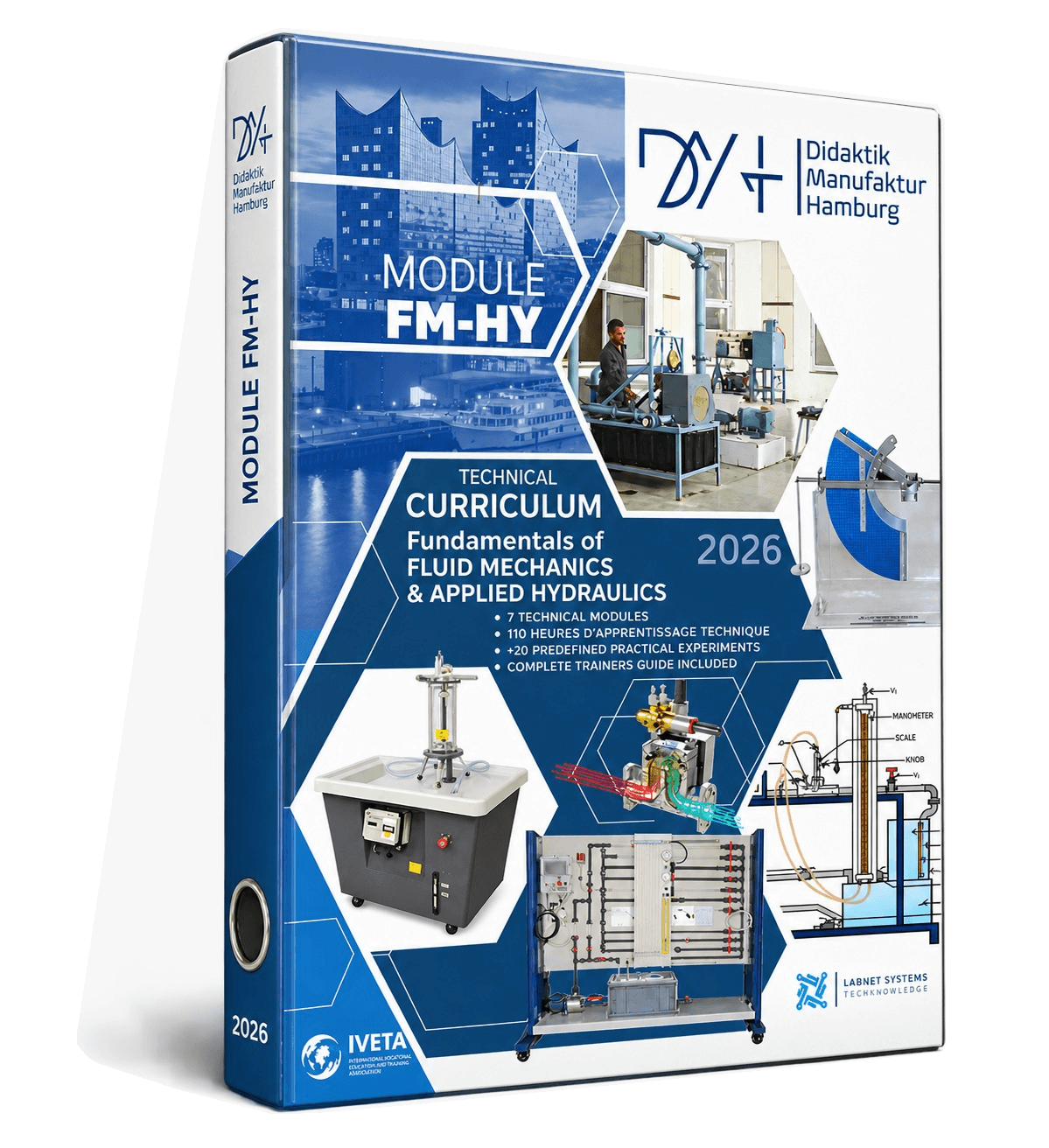
Fundamentals of Fluid Mechanics & Applied Hydraulics
Complementary Practical Training Module
1. General Description
The Fundamentals of Fluid Mechanics & Applied Hydraulics Training Module provides vocational students with essential theoretical knowledge and practical competencies in fluid behavior, hydraulic principles, pump technology, and water flow systems.
Specifically designed to complement technical training in Water Well Drilling, Water Supply, Plumbing, and related disciplines, the module enables students to understand the physical principles governing fluid pressure, flow, energy transfer, and hydraulic performance.
Particular emphasis is placed on the practical application of fluid mechanics in groundwater extraction, pumping installations, pipeline networks, and water distribution systems.
The module combines modern educational training equipment with a structured technical curriculum, predefined practical experiments, measurement exercises, and performance evaluation procedures.
Standard Professional Configuration
Approximately 25–35 equipment and accessory positions
10–20 predefined practical experiments
Recommended training capacity: 18–24 students
Recommended duration: 60–80 training hours
Training structure: approximately 30% theory and 70% practical exercises
Modular configuration suitable for integration into existing vocational training departments
2. Technical Training Contents
The curriculum is structured into six complementary training units.
1 – Fundamentals of Fluid Mechanics
Introduction to the fundamental physical properties of fluids, including density, pressure, viscosity, hydrostatic pressure, flow velocity, and volumetric flow rate. Students learn basic measurement principles and the relationship between pressure, flow, and energy.
2 – Fluid Flow & Pressure Losses
Investigation of laminar and turbulent flow, Reynolds number, Bernoulli's principle, pipe friction, and local pressure losses. Practical exercises demonstrate the influence of pipe diameter, flow velocity, valves, fittings, and pipeline geometry on hydraulic performance.
3 – Pump Technology & Performance
Introduction to centrifugal pumps, submersible pumps, and their applications in water extraction and distribution. Training includes pump characteristics, total dynamic head, efficiency, operating points, cavitation, and basic pump selection principles.
4 – Applied Hydraulics & Water Distribution
Study of hydraulic circuits, piping networks, valves, pressure regulation, flow control, and water distribution systems. Students develop practical skills in assembling, operating, measuring, and troubleshooting basic hydraulic installations.
5 – Groundwater & Well Hydraulics
Introduction to groundwater movement, aquifer characteristics, static and dynamic water levels, drawdown, and well productivity. Practical demonstrations cover groundwater extraction, pumping tests, and the basic interpretation of well performance.
6 – Measurement, Testing & Troubleshooting
Application of pressure gauges, flow meters, measuring instruments, and data recording methods. Students perform practical measurements, calculate hydraulic parameters, analyze operating conditions, and identify common faults in pumping and water supply installations.
3. Standard professional equipment configuration
The training module is based on a coordinated selection of educational apparatus, experimental units, measuring instruments, and accessories.
Main Training Equipment
Fluid Mechanics Training Bench
Hydrostatic Pressure Demonstration Unit
Bernoulli's Principle Experimental Apparatus
Pipe Friction and Pressure Loss Training Unit
Flow Measurement Training Apparatus
Centrifugal Pump Characteristics Training System
Series and Parallel Pump Demonstration Unit
Hydraulic Pipe Network Training System
Groundwater Flow Demonstration Model
Well Pumping and Drawdown Simulation Unit
Additional Equipment & Accessories
Pressure gauges, differential manometers, flow meters, valves, transparent pipe sections, fittings, water reservoirs, measuring cylinders, basic electrical measuring instruments, hoses, connectors, and maintenance tools.
The final configuration may be adapted to the institution's training objectives, available infrastructure, and budget.
4. Examples of predefined practical experiments
The practical curriculum includes structured experiments designed to develop measurement, analytical, and troubleshooting competencies.
Hydrostatic Pressure Measurement — Measure pressure at different water depths and verify the relationship between pressure and liquid height.
Flow Rate Determination — Determine volumetric flow rate using different measurement methods and compare results.
Bernoulli's Principle — Investigate the relationship between flow velocity, pressure, and elevation in a flowing liquid.
Pipe Friction Losses — Measure pressure losses in pipelines with different diameters, lengths, and flow rates.
Centrifugal Pump Characteristics — Determine pump head, flow rate, and operating characteristics under different conditions.
Pump Efficiency — Calculate hydraulic power and overall pump efficiency using measured operating data.
Series & Parallel Pump Operation — Compare pressure and flow characteristics of pumps operating individually, in series, and in parallel.
Groundwater Drawdown Simulation — Observe and measure the influence of pumping on groundwater levels using a demonstration model.
Well Pumping Capacity — Perform a simulated pumping test and evaluate discharge, drawdown, and specific capacity.
Water Supply Troubleshooting — Identify pressure losses, flow restrictions, air ingress, and other common operating problems.
Additional experiments may cover Reynolds number determination, valve characteristics, flow regulation, cavitation demonstration, and basic hydraulic system optimization.
5. Technical Curriculum & educational documentation
The module is supplied with a structured technical training curriculum designed to support both instructors and students.
The educational documentation may include:
Instructor's Guide with teaching objectives and methodological recommendations
Theoretical background and technical explanations
Predefined practical experiment worksheets
Experimental setup diagrams and equipment instructions
Measurement tables and calculation exercises
Student questions and corresponding answer sheets
Practical competency evaluation forms
Safety instructions and laboratory operating procedures
Equipment maintenance and inspection guidelines
Each predefined experiment follows a standardized educational structure covering the learning objectives, required equipment, theoretical background, experimental procedure, measurement results, calculations, evaluation questions, and expected learning outcomes.
6. Learning outcomes & department integration
Upon successful completion of the module, trainees will be able to:
Explain fundamental fluid mechanics and hydraulic principles.
Measure and calculate pressure, flow rate, velocity, and hydraulic losses.
Interpret basic pump performance curves and operating conditions.
Understand the hydraulic behavior of water extraction and distribution systems.
Perform elementary groundwater pumping and drawdown analyses.
Identify and troubleshoot common hydraulic system problems.
Apply appropriate safety procedures and measurement techniques.
Modular Training Concept
The Fundamentals of Fluid Mechanics & Applied Hydraulics Module can be integrated into an existing vocational training department or implemented as an independent practical training laboratory.
Its modular structure allows institutions to expand their technical training capabilities progressively while maintaining compatibility with related engineering and water technology disciplines.
DMH – Integrated Technical Training Solutions
Coordinated Training Equipment | Practical Curriculum | Installation & Commissioning | Instructor Training | Technical Support
Contact us for assistance with your project!
Take advantage of our experience and expertise. We will be happy to send you a personalized quote.
Your Didaktik Manufaktur Hamburg Team