
Extension module · AG-NW
Metallurgy, Material Science & Applied Mechanics
Overview
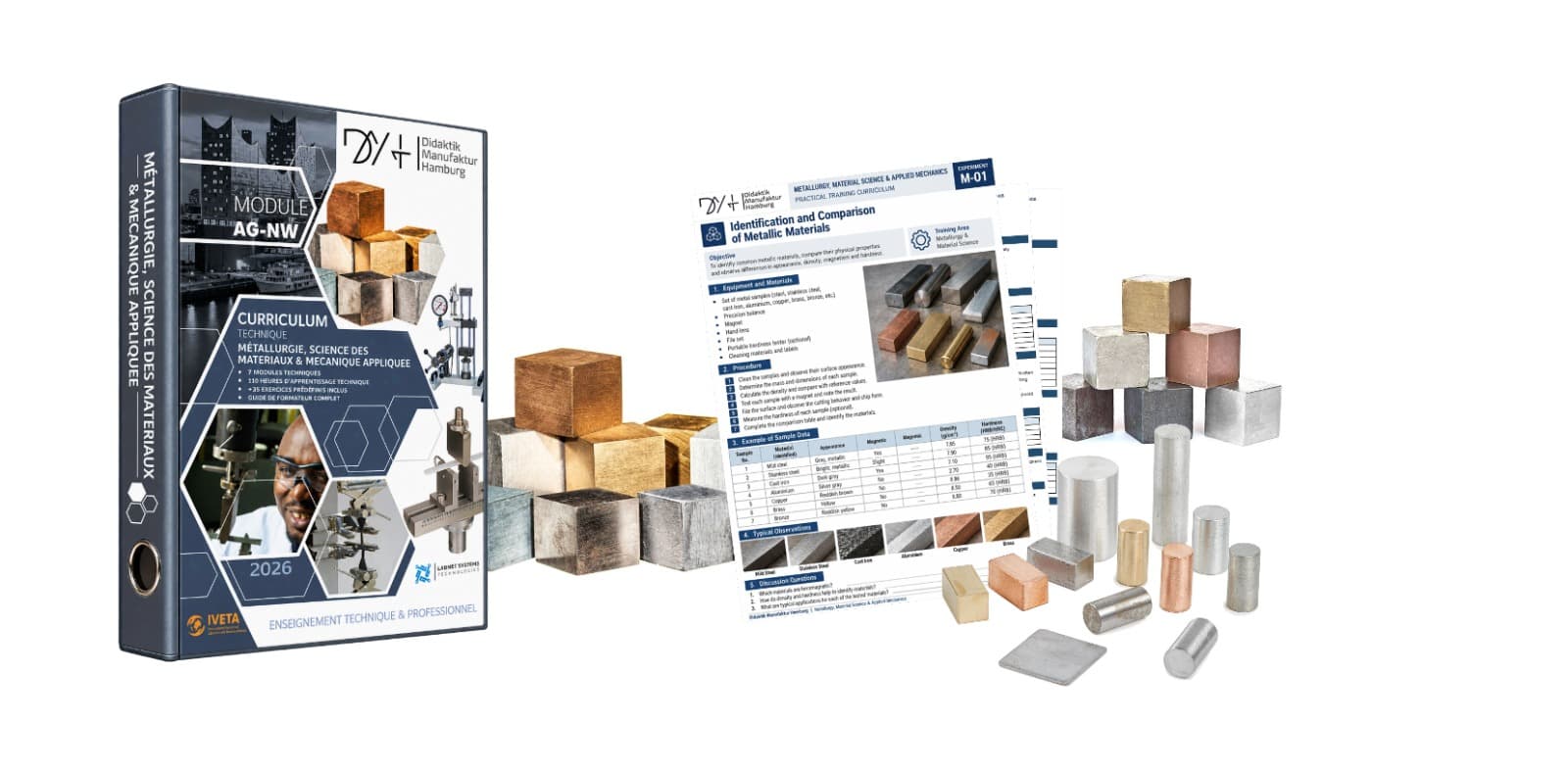
The DMH Metallurgy, Material Science & Applied Mechanics Training Module provides a comprehensive, practice-oriented introduction to metallic materials, their mechanical properties, testing methods and industrial applications.
Designed for vocational schools, technical colleges and industrial training centers, the module combines fundamental engineering theory with practical laboratory experiments, enabling trainees to understand material behavior, mechanical forces, deformation, heat treatment and failure mechanisms.
The training solution can be implemented as a standalone educational module or seamlessly integrated as an optional extension to the DMH Mechanics & Toolmaking Department, as well as other related technical disciplines.
Main training areas
1. Metallurgy & Material Science
Identification and classification of ferrous and non-ferrous metals
Properties and applications of common engineering alloys
Fundamentals of metallic microstructures and material behavior
Material selection for industrial manufacturing
2. Material Testing & Mechanical Properties
Hardness testing and material comparison
Tensile, compression and bending tests
Elasticity, plasticity, strength and deformation
Introduction to material fatigue and fracture analysis
3. Heat Treatment & Metallurgical Processes
Fundamentals of annealing, hardening and tempering
Temperature measurement and controlled heating
Quenching techniques and cooling processes
Effects of heat treatment on material properties
4. Applied Mechanics & Strength of Materials
Forces, moments and mechanical equilibrium
Stress, strain and material deformation
Bending, torsion, friction and mechanical loading
Basic engineering calculations and mechanical principles
5. Industrial Material Behavior & Failure Analysis
Wear, corrosion and material degradation
Surface properties and material performance
Identification of common material failures
Practical material selection for industrial applications
Practical training curriculum
The module includes a structured practical training curriculum with approximately 30 predefined laboratory exercises and technical experiments, covering:
Identification and comparison of metallic materials
Hardness measurement of different steel grades
Tensile testing and interpretation of stress–strain diagrams
Compression and bending experiments
Investigation of elastic and plastic deformation
Basic metallographic sample preparation and microstructure examination
Heat treatment experiments: annealing, hardening and tempering
Evaluation of material properties before and after heat treatment
Force equilibrium and mechanical leverage experiments
Beam deflection and torsion measurements
Friction and mechanical resistance experiments
Corrosion and wear demonstrations
Basic failure analysis and material selection exercises
Each training unit is supported by technical explanations, practical instructions, experiment worksheets, safety guidelines and evaluation procedures.
Training equipment & laboratory configuration
The standard professional configuration includes a carefully selected range of educational testing equipment, metallurgical instruments, mechanical training apparatus, laboratory accessories and material sample collections.
Typical equipment includes:
Universal material testing machine with testing accessories
Hardness testing equipment
Digital metallurgical microscope and sample preparation tools
Compact heat treatment furnace and quenching accessories
Applied mechanics and strength-of-materials training systems
Force, bending, torsion and friction experiment apparatus
Metal and alloy sample collections
Corrosion, wear and material failure demonstration kits
Laboratory workbenches, measuring instruments and safety equipment
Equipment selection and laboratory configuration can be adapted to the institution's training objectives, available facilities and budget.
Training concept & learning outcomes
Through the combination of theoretical instruction and practical experimentation, trainees acquire the ability to identify engineering materials, evaluate their mechanical properties, understand basic metallurgical processes and apply fundamental mechanical principles to real industrial situations.
Recommended training duration: approximately 120–150 hours
Training capacity: up to 24 trainees
Training approach: theory combined with supervised practical laboratory exercises
Configuration: standalone module or integrated departmental extension
DMH integrated training solution
DMH provides a coordinated educational solution combining appropriate equipment selection, laboratory planning, technical documentation, installation and commissioning, instructor training and a structured practical curriculum.
The module is designed to complement existing vocational training programs while strengthening trainees' technical understanding of materials, manufacturing processes and mechanical engineering principles.
A modular, expandable and industry-oriented training solution tailored to modern vocational and technical education.
Of course the configuration of the workshop can be adapted to your specific goals.
Contact us for assistance with your project.
Take advantage of our extensive experience and expertise.
Your Didaktik Manufaktur Hamburg Team