Computing & AI
For secondary schools
Our Computing & AI kits empower students to understand and help shape digital technology through hands-on, project-based learning that prepares them for careers in computer science, engineering and the data-driven economy.
Computing and artificial intelligence drive innovation, help address global challenges and form the foundation of nearly every future profession.
Each kit contains a focused set of hands-on projects specifically designed for classroom use through to the end of upper secondary education.
What's in the Set
All projects include detailed manuals and experiment instructions.
A complete set covering seven focus areas is designed for four to six students.
Mathematics integration: Mathematical references have been added to each kit to strengthen the connection between mathematics and computer science.
Curriculum alignment: The experiments are aligned with NGSS, national curricula (including German curricula) and PISA standards to meet the highest educational requirements.
Classroom practicality: Each kit contains a manageable number of projects that are easy to integrate into everyday school life.
All kits are supplied with complete materials, instructions and digital resources, including offline-capable software, to make learning engaging and effective.
Your Benefits
Innovative stackable box system — modular, clearly organised and expandable
Strong, age-appropriate integration of mathematics
High durability and classroom practicality for schools
Alignment with international and national standards
Step-by-step build-up of a complete physics laboratory
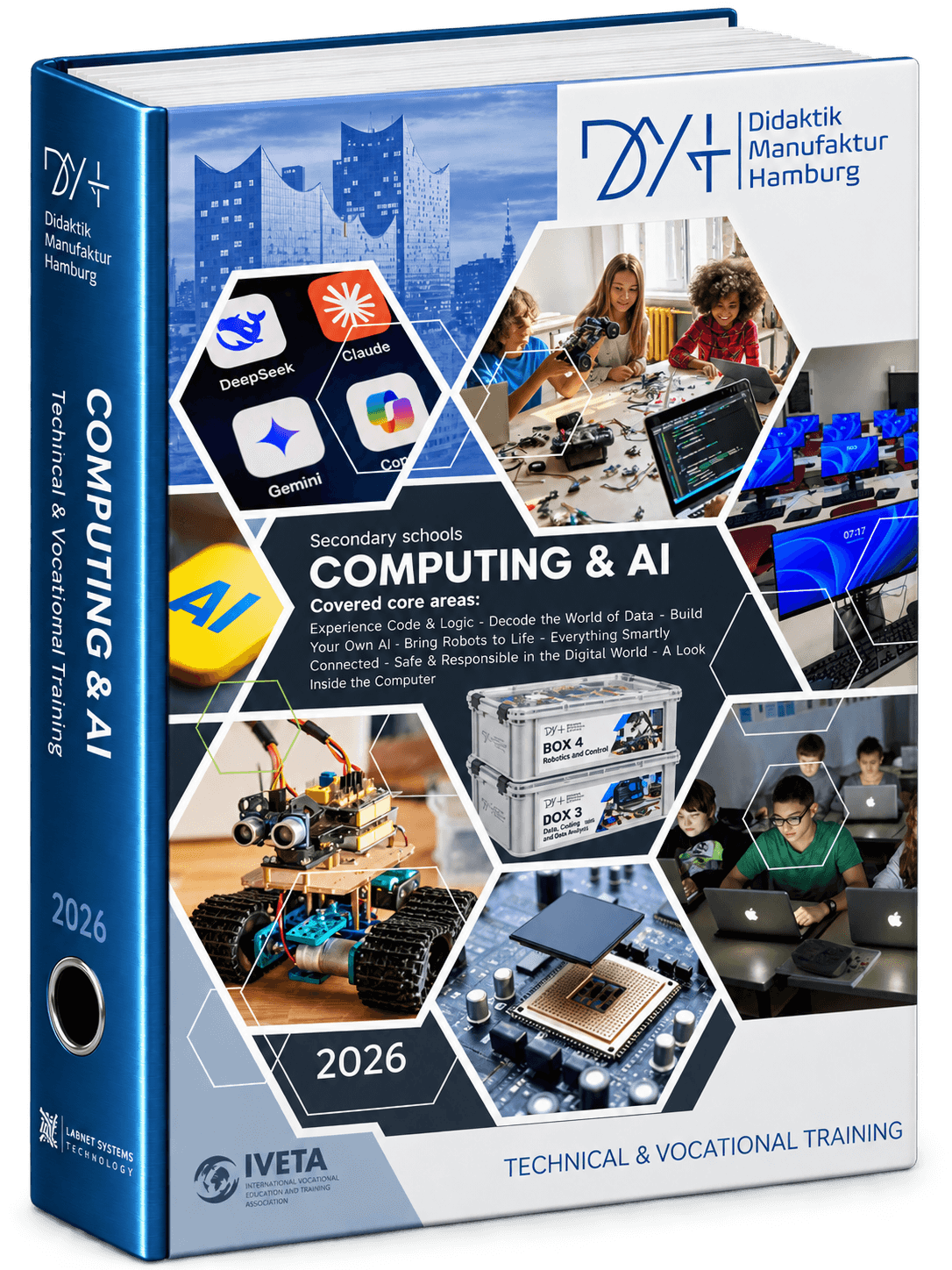
Covered core areas:
Experience Code & Logic · Decode the World of Data · Build Your Own AI · Bring Robots to Life · Everything Smartly Connected · Safe & Responsible in the Digital World · A Look Inside the Computer
Contents of the Seven Boxes:
Box 1: Programming and Algorithms
Topics: algorithmic thinking, block- and text-based programming, control structures, algorithms, software development
Programming with loops and conditions.
Drawing and moving objects on a coordinate grid.
Designing and testing everyday algorithms such as searching and sorting.
Creating a program using functions and lists.
Structuring a larger program with data sets and modules.
Testing, debugging and improving a program through the software development process.
Box 2: Data, Coding and Data Analysis
Topics: data representation (binary, hexadecimal, text, image, sound), data collection, data analysis, databases
Representing numbers and text in binary.
Capturing and cleaning a real data set.
Encoding images and sound in hexadecimal and comparing compression.
Creating charts and dashboards.
Building and querying a simple database using SQL.
Analysing data and identifying trends.
Box 3: Machine Learning and Artificial Intelligence
Topics: how machines learn, classification, neural networks, deep learning, generative AI, AI agents, AI ethics and society
Training a simple image or speech classifier.
Exploring decision trees using real-world examples.
Investigating how a neural network weights inputs.
Critically evaluating generative AI outputs and identifying misinformation.
Building and testing a simple AI agent that responds to its environment.
Designing and optimising your own AI model, from data preparation to inference.
Exploring the basic idea of large language models and knowledge representation.
Comparing deep learning with unsupervised and reinforcement learning using a small example.
Assessing the impact of AI on society and the labour market.
Box 4: Robotics and Control
Topics: sensors and actuators, physical computing (micro:bit, Arduino), control loops, robot programming, automation
Building and programming a mobile robot.
Reading sensor values and responding to them.
Implementing a closed control loop, for example line following.
Programming a robotic arm for a sequence of movements.
Box 5: Networks, the Internet and the Internet of Things
Topics: computer networks, the internet, protocols and addressing, the Internet of Things, connected systems
Setting up a small local network and exchanging messages.
Connecting a sensor to an IoT platform.
Exploring how the internet works: protocols, layers and IP and MAC addressing.
Comparing network topologies and measuring data transmission.
Box 6: Information Security, Data Protection and Digital Responsibility
Topics: cybersecurity, encryption, data protection and data protection law, copyright, information systems, digital ethics and human–AI collaboration
Investigating data protection in everyday apps.
Exploring how passwords and keys protect data.
Encrypting and decrypting messages using classical methods.
Discussing and documenting responsible use of AI.
Understanding and building a small information system, such as a class database or a booking system.
Examining copyright, licences and data protection rules for software and data.
Designing a human–AI collaboration workflow and evaluating the distribution of roles.
Box 7: Computer Systems and How Computers Work
Topics: computer architecture (processor, memory, storage), Boolean logic and logic gates, operating systems and system software
Exploring the components of a computer and how data flows between the processor, memory and storage.
Building simple logic circuits using AND, OR and NOT.
Investigating how the processor executes a program and how memory and storage work together.
Exploring the role of the operating system and system software.
Contact us for assistance with your project
We will be happy to send you a personalized quote accompanied by one or more useful extension options and modules.
Your Didaktik Manufaktur Hamburg Team