STEM
For primary & secondary schools
Our experimental Kits equip students to solve real-world problems through practical, engaging learning, preparing them for careers in science, engineering, and technology.
STEM subjects drive innovation, address global challenges, and underpin future careers.
Each STEM kit includes a focused set of experiments.
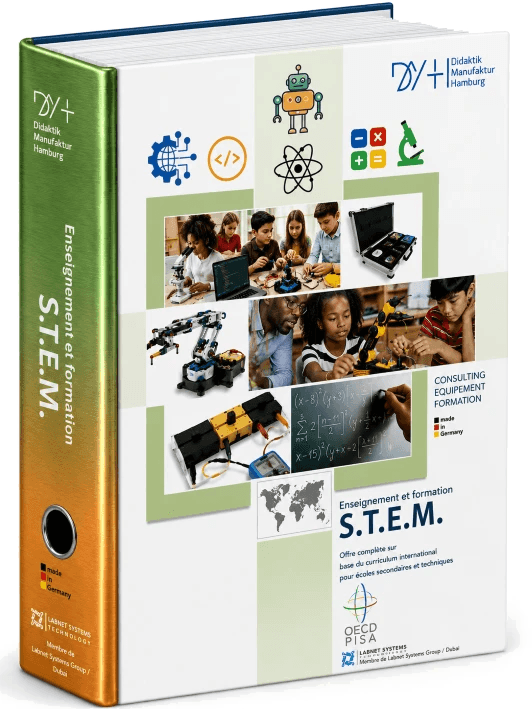
Content of the complete STEM-Set
All experiments include comprehensive manuals and experiment guides.
One complete set, covering six focus areas, is designed for four to six students.
Mathematics Integration: Mathematical aspects were added to each kit to strengthen the connection between mathematics and the other STEM areas.
Curriculum Review: The experiments were reviewed according to NGSS, German curricula, and PISA standards to ensure they meet the requirements.
Practicality: Each kit contains a manageable number of experiments that can easily be integrated into the school routine.
All Kits are delivered with complete materials, instructions, and digital resources to make learning engaging and effective.
The coordinated content is supplied in durable and robust boxes.
Content of the kits
Box 1: Fundamentals of Physics
Topics: Mechanics, Electricity, Optics, Energy
Experiments:
Measurement of acceleration and velocity – Connection to Mathematics: Analysis of motion data (graphs, equations).
Investigation of electromagnetic fields – Connection to Mathematics: Calculation of field strengths and potentials.
Analysis of motion with accelerometers – Connection to Mathematics: Differential calculus (derivatives of position-time functions).
Construction of mechanical systems (e.g., levers, gears) – Connection to Mathematics: Calculation of forces and torques.
Box 2: Chemistry and Materials Science
Topics: Chemical Reactions, Analytical Chemistry, Electrochemistry, Material Properties
Experiments:
Investigation of gas laws – Connection to Mathematics: Ideal gas law (proportionalities).
Titration experiments – Connection to Mathematics: Stoichiometry (calculation of concentrations).
pH measurement and conductivity – Connection to Mathematics: Data analysis (trend lines, correlations).
Acid-base reactions – Connection to Mathematics: pH calculations (logarithms).
Box 3: Biology and Environmental Science
Topics: Microscopy, Genetics, Ecology, Sustainability Experiments
Box 4: Technology and Robotics
Topics: Programming, Robotics, Renewable Energy, Data Collection Experiments
Experiments:
Construction of electrical circuits – Connection to Mathematics: Ohm's law (calculation of current, voltage, resistance).
Measurement of solar cell power – Connection to Mathematics: Energy conversion efficiency.
Data analysis with sensors – Connection to Mathematics: Data visualization (graphs, charts).
Construction and programming of robots – Connection to Mathematics: Algorithms, coordinate systems.
Box 5: Engineering and Construction
Topics: Mechanics, Electrical Engineering, Construction, Energy Conversion
Box 6: Mathematics and Data Analysis
Topics: Geometry, Algebra, Statistics, Modeling Experiments
Contact us for assistance with your project
We will be happy to send you a personalized quote accompanied by one or more useful extension options and modules.
Your Didaktik Manufaktur Hamburg Team