Cassava Processing & Fufu Production
Back to Technical & Vocational Education DepartmentsWorkshop for Cassava flour with complete production line
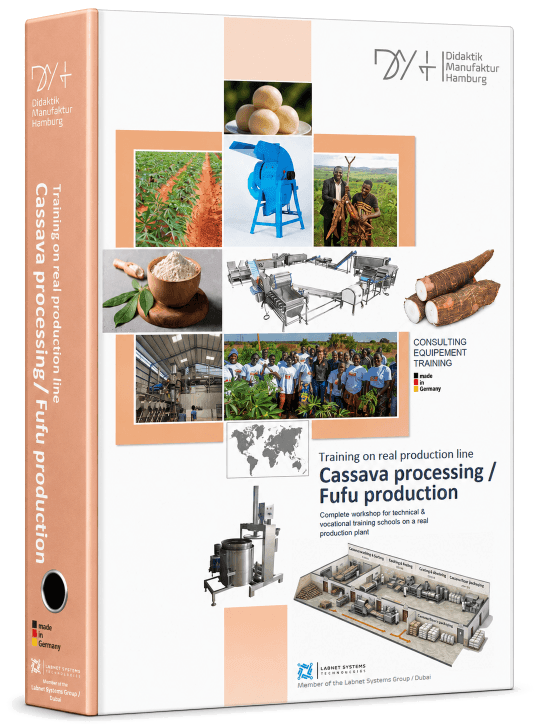
The processing of cassava into high-quality cassava flour and fufu is a demanding process that requires in-depth knowledge and suitable equipment.
For trainees being trained in this professional field, access to high-quality technology and comprehensive guidance is essential to learn correct techniques and build a solid professional foundation.
This comprehensive offer provides all the necessary tools and machines for trainees, vocational schools, and training programs in cassava processing technology. It is a turnkey solution that ensures a safe, efficient, and productive learning environment.
Key Features
The cassava processing workshop is designed in its standard configuration for 18 to 24 trainees (expandable).
The workshop is fully equipped and 100% compliant with international standards and norms (food safety, hygiene, quality control).
The professional equipment covers all processing steps for cassava – from cleaning and peeling through grating/crushing, dewatering/pressing, flash drying to sieving, milling, quality control, and filling/packaging.
The annual production capacity of the standard equipment is approximately 30 tons of cassava flour/fufu (corresponding to a small to medium-sized training and demonstration facility).
The plant enables the production of various cassava products (high-quality cassava flour, odorless instant fufu, garri, tapioca starch). Processing methods, recipes, and process parameters are included in the delivery.
Advanced training for instructors is essential for the optimal operation of the workshop.
In addition to on-site training after installation and commissioning, a 10–12 day intensive training program is conducted at our production partner’s facilities (prior to equipment shipment). This training covers all process details as well as hygiene, maintenance, and quality control.
A comprehensive set of essential and practical accessories – selected based on the experience of professional cassava processors – completes the workshop and makes it a fully turnkey solution.
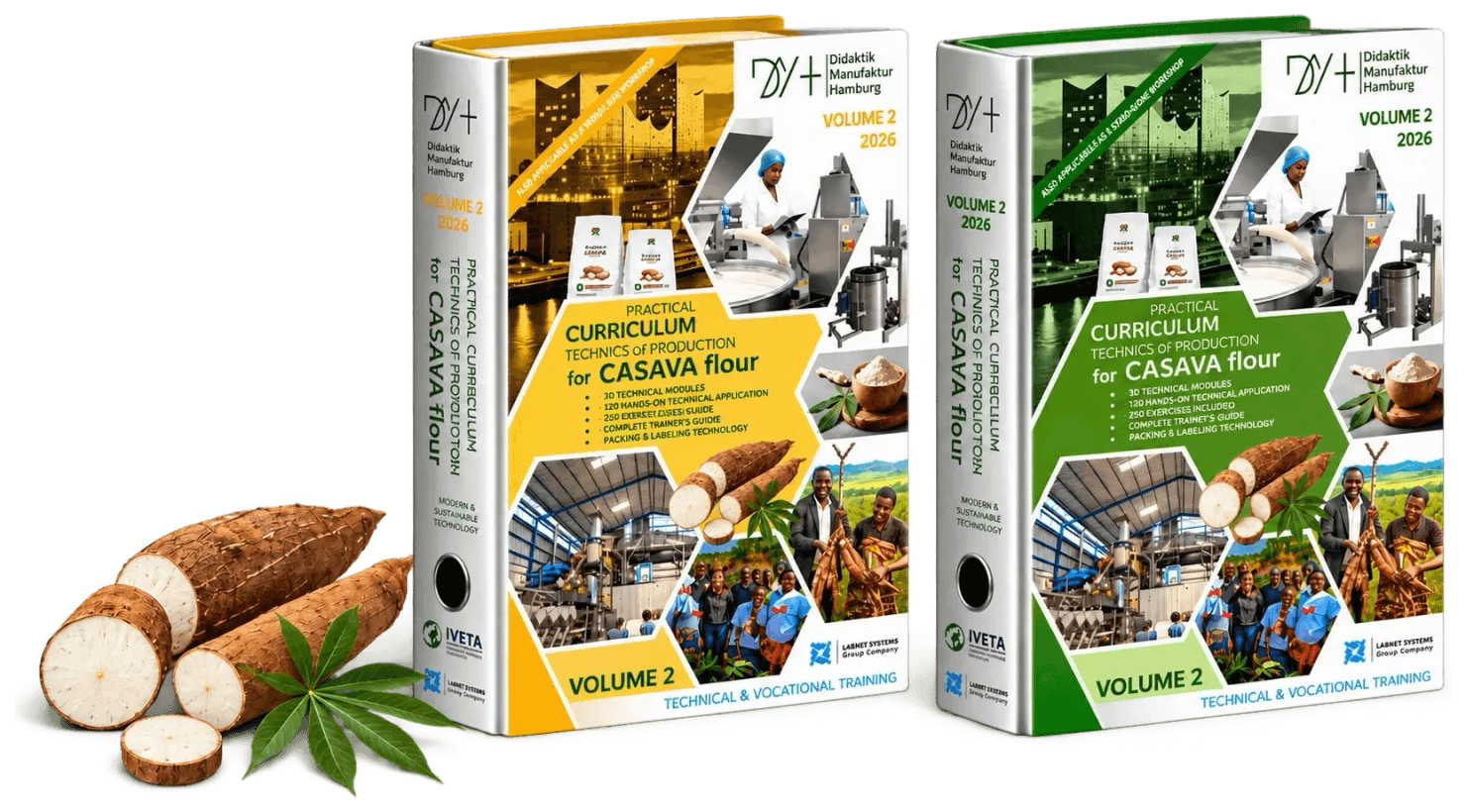
Complete technical & practical Curriculum with predefined exercises and Structured Teaching & Practical Training Programme.
Didactic Content
The training program is specifically designed for vocational schools and training institutions in cassava processing.
The goal is to train professionals who master the entire process – from raw material to marketing – while complying with quality, hygiene, and safety standards.
The program is structured progressively and combines theoretical instruction, practical exercises, case studies, and applied projects.
Upon completion of the training, participants will be able to:
Understand the scientific and technical principles of cassava processing
Select and use raw materials (cassava varieties, water, fermentation cultures)
Independently carry out all processing steps and phases of the processing process
Control product quality, stability, and safety
Develop recipes and produce various cassava products (flour, fufu, etc.)
Manage a small-scale production or micro-processing unit from a technical, legal, and economic perspective
Program Structure by Module
Module 1 – Introduction to Cassava Processing
Module 2 – Raw Materials
Module 3 – Science of Cassava Processing
Module 4 – Processing Process
Module 5 – Equipment and Installations
Module 6 – Quality Control and Sensory Analysis
Module 7 – Recipe Development and Innovation
Module 8 – Regulations, Hygiene, and Safety
Module 9 – Business Management and Entrepreneurship in Cassava Processing
Module 10 – Final Project
Self-Financing Opportunities
In addition to its purely educational function, the workshop offers an excellent opportunity for self-financing.
This can be achieved through the direct sale of the final product (a filling system and labeling machine are included in the offer).
With the production capacity, significant revenue potential arises that can cover ongoing operating costs and contribute to financing further training programs.
Practical training Curriculum (what is that?)
for Production of CASSAVA flour (Fufu)
Included as an integral component of every workshop.
(Each curriculum is individually adapted to the specific requirements of the workshop.)
- +50 weeks full-time training
- +1,500 hours hands-on working time
- +10 modules with exercise instructions
- +100 pre-defined practical exercises
- +Full operational turnkey unit
- +7 workstations
- +18 to 24 apprentices per group (expandable)
Optional Extensional Departments
Optional extensions through complementary Departments can significantly expand the technical scope,
broaden practical skills and competencies, and provide opportunities for advanced specialization in specific fields of expertise.
Optional extension Modules
In addition to our core offering, we provide optional extension MODULES that can be integrated
into your institution's infrastructure:
From fresh roots to cassava flour and fufu
How the Cassava Processing Department turns fresh roots into flour and fufu — twelve steps, from the field to the customer.
Optional extensions — click to add
Click a step to highlight it in the model.

Contact us for assistance with your project.
Take advantage of our extensive experience and expertise.
We will be happy to send you a personalized quote accompanied by one or more useful extension options.
Your Didaktik Manufaktur Hamburg Team