Professional Emergency Care
Back to Technical & Vocational Education DepartmentsPractical Training Workshop Equipment
Modern skills lab & simulation workshop for first aid, resuscitation & complex emergency scenarios with professional equipment for practical training of first responders and emergency personnel.
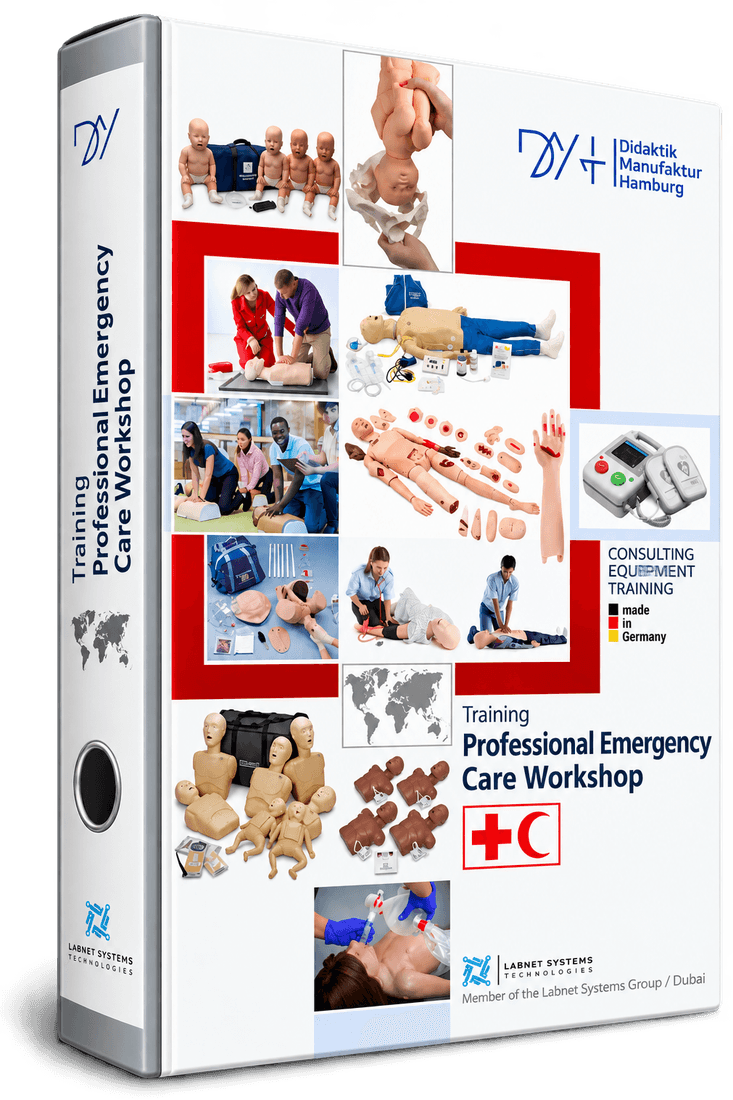
Practical Training Workshop & Curriculum
A modern skills lab and simulation centre for professional emergency and prehospital care, equipped for the hands-on training of emergency care providers and first responders.
Why Professional Emergency Care?
In real emergencies, every second counts, and the quality of training often determines the outcome.
A basic first-aid course with a simple manikin is no longer enough. Current guidelines (ERC 2025, AHA, PHTLS, Stop the Bleed) and real-life situations demand realistic, repeatable and measurable training.
All clinical and advanced skills are taught as simulation under qualified, state-certified instruction.
Who is this program for?
Emergency medical and ambulance services
Hospitals, clinics and health centres
Nursing and medical training institutions
Companies and industrial HSE teams, including remote sites
Public safety organisations such as fire services and civil protection
NGOs and Red Cross or Red Crescent societies
Ministries of health and vocational training centres
In short: wherever professional emergency care must be delivered and its providers trained.
Key reasons for this program
Life-saving skills must be mastered, even under stress. Correct compression depth, rate, full release and effective ventilation are reached by very few without regular, objective feedback.
Stopping bleeding is the number one preventable cause of death. Massive external bleeding kills faster than cardiac arrest, so realistic training with pulsatile bleeding and tourniquet and packing drills is essential.
Trauma is a daily reality. Traffic, workplace, fall and everyday injuries require structured assessment and treatment using the primary and secondary survey and the (c)ABCDE approach.
Airway emergencies are common and deadly. Obstruction, aspiration, asthma and trauma require correct clearing, bag-mask ventilation and supraglottic airway skills.
Emergencies in vulnerable populations. CPR on obese patients, childbirth emergencies and paediatric emergencies require specialised simulators for the elderly, obese, children and pregnant patients.
Proof of quality and documentation. Services, companies and institutions must show that training follows current standards, including documentation and debriefing.
Long-term cost efficiency. Durable, high-quality simulators withstand years of intensive use and reduce downtime due to repairs.
What the program trains on :
Resuscitation & CPR (with feedback). BLS simulators (light and dark skin), Bluetooth feedback, professional CPR trainers, obese and geriatric manikins, AED trainers and bag-mask sets.
Bleeding Control & Tourniquet. Arm and leg bleeding trainers, pulsatile bleeding systems, training tourniquets (CAT, SOF-T, SWAT-T), hemostatic and wound-packing materials.
Trauma & Hyper-Realistic Moulage. Moulage sets, open fracture models, casualty simulation kits and realistic wound representation.
Airway & Ventilation. Intubation and airway simulators, precision test lungs, ventilation and obstruction trainers and difficult-airway models.
Monitoring & ALS Bridge. Simulated patient monitors (ECG, SpO2, BP, defibrillator), connectivity upgrades and wireless scenario control and debriefing tools.
Special Scenarios & Emergency Birth. Birthing simulators and stages, pregnancy model series and PHTLS trauma trainers.
Paediatrics & Vulnerable Groups. Infant and child simulators and models for special patient groups.
Hygiene & Consumables. Gloves, FFP2 masks, face shields, gowns, disinfection, replacement lungs, disposable airways, dressings and training hemostatics.
Valid professional instruction.
All advanced and invasive skills are trained as simulation under qualified, state-certified medical instruction and do not confer authorisation to perform invasive procedures independently.
Recognition of qualifications is granted through accredited bodies.
Tactical and invasive content, such as surgical airway, chest decompression and drainage and combat trauma, is offered in the companion module Tactical Edition / Sauvetage au Combat.
Your advantage
You do not just train first aid. You prepare professional responders for real, life-threatening situations with measurable success, high realism and verifiable quality. This saves lives and provides legal and operational security.
Contact us to tailor the standard package to your training requirements, for emergency services, hospitals, public safety organisations, companies, schools or ministries.
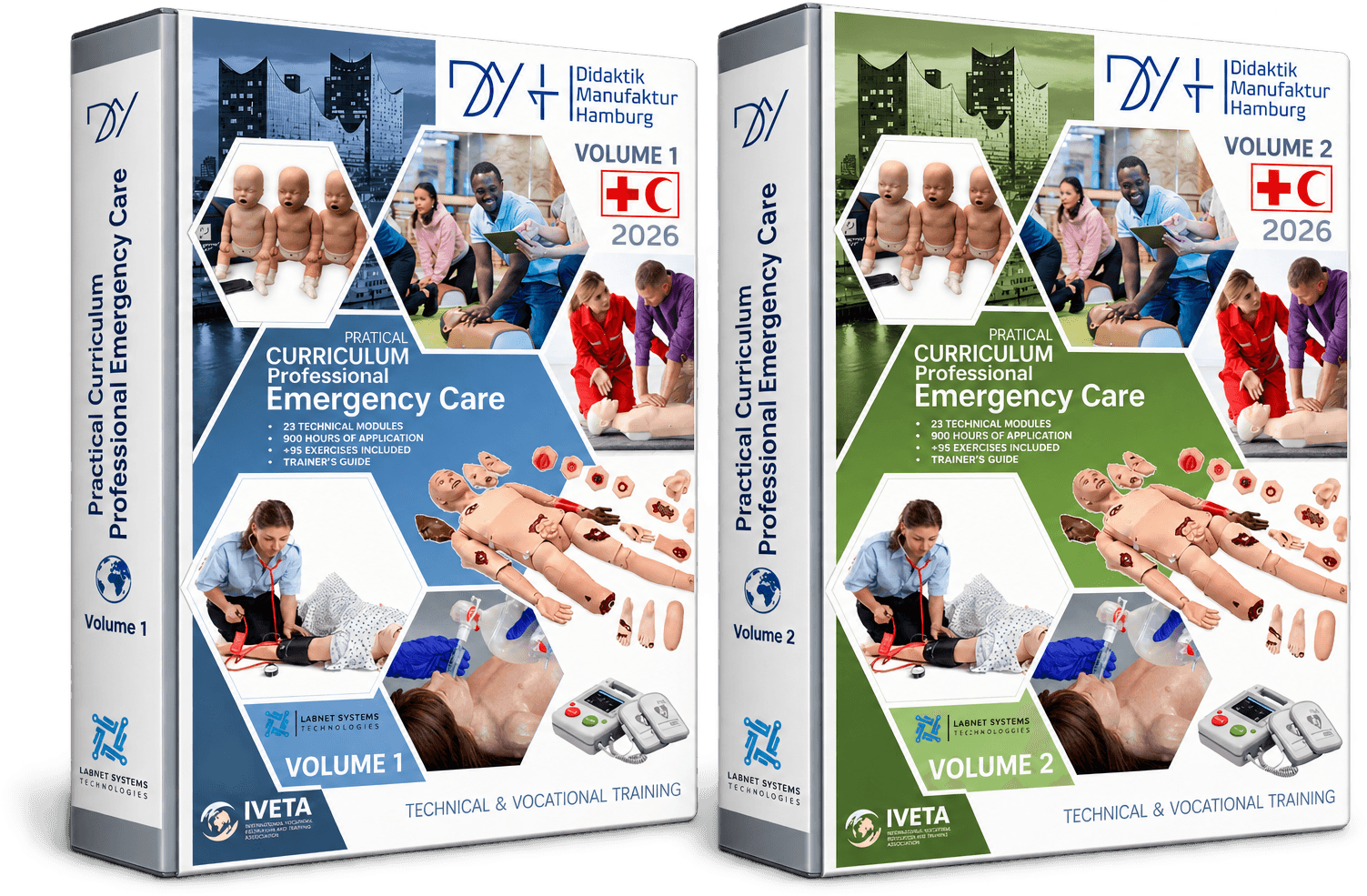
Practical training Curriculum (what is that?)
for Professional Emergency Care
Included as an integral component of the workshop.
(Each curriculum is individually adapted to the specific requirements of the workshop.)
- +2 years full-time training
- +900 hours hands-on working time
- +23 modules with exercise instructions
- +96 pre-defined practical exercises
- +75 individual training equipment items
- +10 workstations
- +18 to 22 apprentices per group (expandable)
Contact us for assistance with your project.
Take advantage of our extensive experience and expertise.
We will be happy to send you a personalized quote accompanied by one or more useful extension options and modules.
Your Didaktik Manufaktur Hamburg Team